

April 16, 2025
“Congress shall make no law respecting an establishment of religion, or prohibiting the free exercise thereof; or abridging the freedom of speech, or of the press; or the right of the people peaceably to assemble, and to petition the Government for a redress of grievances.” First Amendment to the Constitution
So much has happened in so few days, that I feel like I have been left speechless or at least … wordless. To be a writer in these days has begun to feel threatening. The fear is that the words we write (or even the words we say) can someday be held against us …and maybe not even in a court of law. We grew up believing that The Constitution guaranteed free speech. Now, I am not so certain. I guess this is where the use of metaphors might come in handy, in that it is a way of expressing an idea by comparing it to something else. You understand …
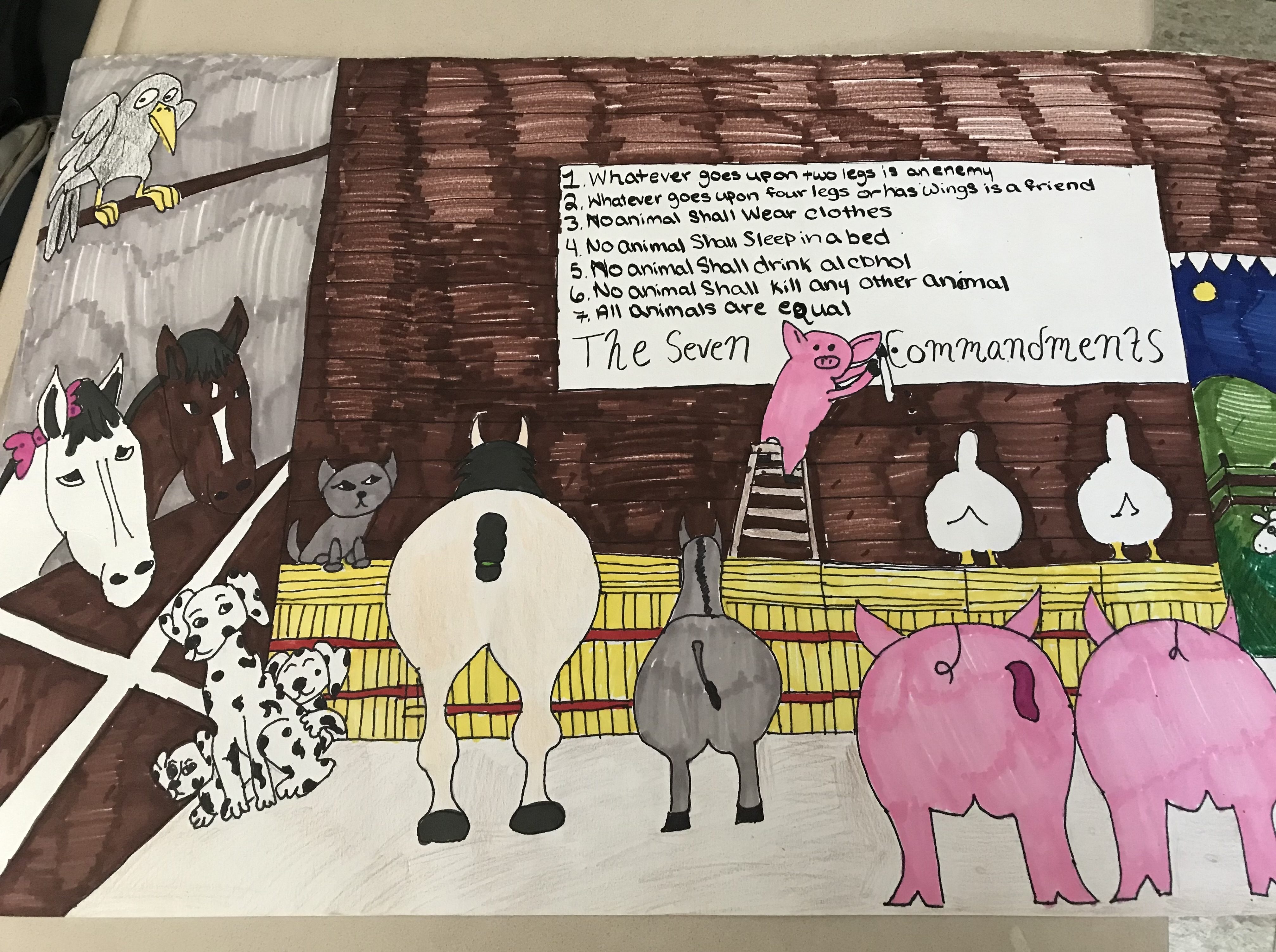
So many writers have used the art of metaphor to get their point across in turbulent times. I’m thinking of George Orwell’s Animal Farm today. I used to tell my students that yes, it is a fable about farm animals, but it also about so much more. In Orwell’s allegory, the animals take over the farm because it is being run by a greedy owner who only looks out for his own welfare. Their hope is that they can create a better place to live and thrive: a farm run by and for the animals and with their best interests in mind.
Unfortunately, the animal run farm soon becomes even more corrupt than the one it replaced. The pigs, which are considered the smartest animals, slowly begin to take control of the farm. The story tells of the destruction of the fervent ideals that the animals once believed in. It is a sad sort of fable, but it is meant as a lesson about the dangers of unchecked power and the effect it can have on a society. The book shows the reader the destructive forces of power and greed, but it also touches on the importance of education and the consequences of being ignorant and ill-informed. Though the animals try their hardest to learn to read and write, they are not able to understand complex ideas, and so they go along with what their leaders say. The pigs, which represent the greediest of human beings, use their supposed intellect to fool the other animals into believing that the harsh rules they created are for the animal’s own benefit. Of course, the pigs themselves do not have to follow these rules.
The Russian revolution of 1917 was the inspiration for Orwell’s cautionary tale, and I’m thinking it deserves a reread. The whole book is a type of extended metaphor. It was written in 1945 when Joseph Stalin was first coming into power. In it, Orwell tried to warn his readers about the dangers of totalitarianism. He chose the inhabitants of a fictional farm as a universal way to express ideas that everyone could understand. He wrote in a way that could go under the radar because, after all, what could be dangerous about a group of farm animals? And who cares about metaphors, anyway. I’m feeling like the lessons Orwell tried to teach to the readers of his time are still ones that we can learn from today.

