

August, 2025
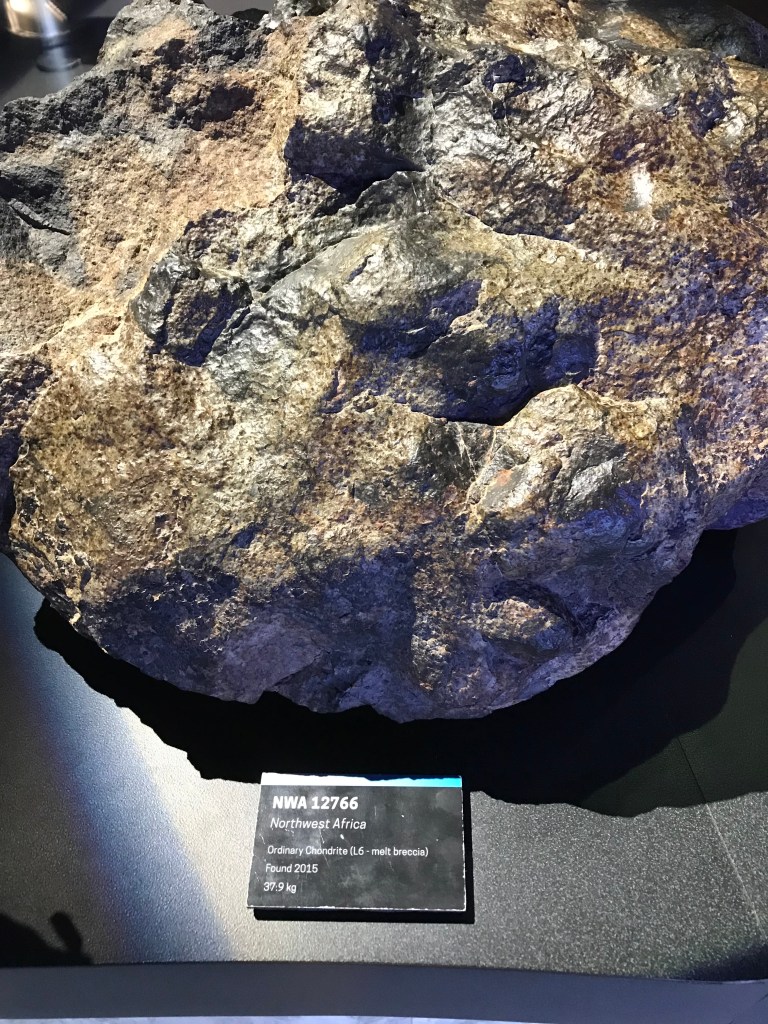
If you find yourself in Maine, take some time to wind your way through Fryeburg and Lovell and other lovely little backroad towns to The Maine Mineral and Gem Museum in Bethel. In shiny glass cases on the fourth floor, the serious rocks are housed. Here, various meteorites and other celestial objects from all parts of the globe and beyond are on display. It is said that the gem museum is the only place on Earth where one can hold a piece of the Moon and Mars at the same time. Each time I visit, I hope to get a little closer to an understanding of how the universe was made. And each time, I end up feeling a little further away from discovering the truth.
This year, one of the museum’s founders was on hand to lend a tour of the fourth floor to let my grandkids and me get a first-hand feel of many of the objects on display. I’ve held the Moon and Mars rocks many times over the years. They are dark and heavy for their size and have a metallic feel about them like a giant rough magnet. They seem unique sitting there on display, but I imagine if I was walking along a rocky beach, it would be easy to dismiss them as just another rock washed ashore.
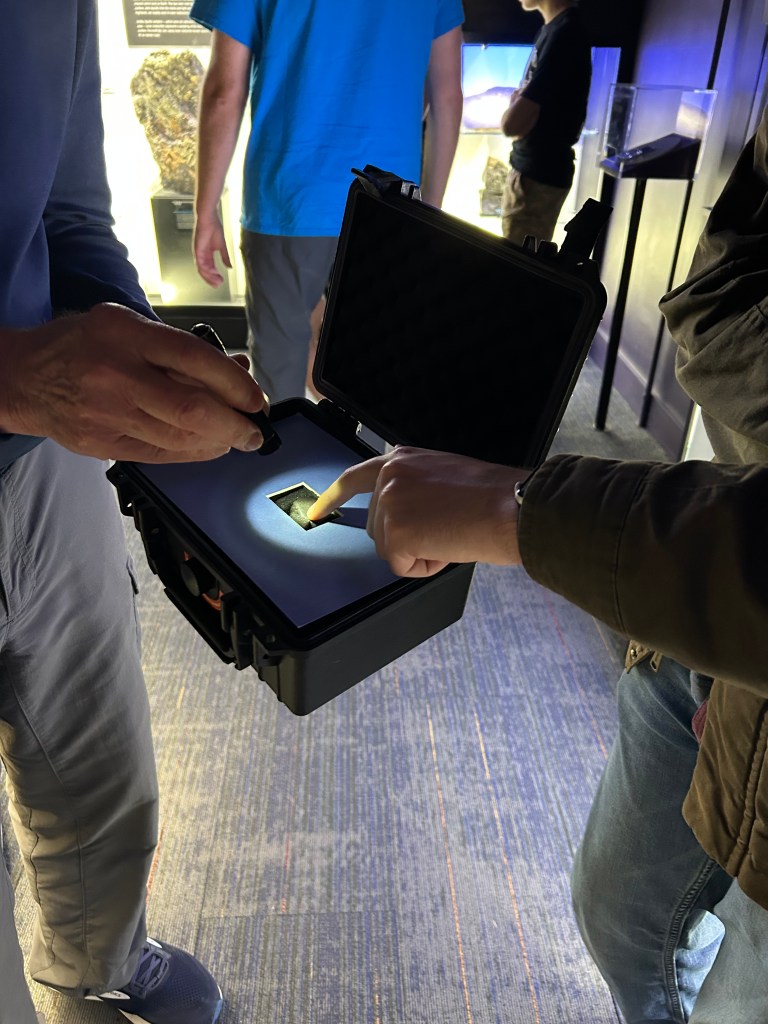
Our tour director was sure to make it a point to tell our small group that we are all made from stardust, and he worked to prove this point at the grand finale of the tour when his assistant brought out a piece of a star. It is mounted in a small box with a peephole where one can gently touch the smooth hard surface. I was able to give the little star a good rub, like one might rub a Buddha in the hopes of gaining some good luck. I imagine that I am still carrying a bit of that stardust with me.

The story of its origin and how it made its way to Earth is a complicated one. I must admit, it does not get easier to understand the more times I hear it. In fact, it is a story that makes my head spin with wonder and disbelief. Somehow billions of years ago, give or take a few million, objects in space collided to create our sun. The particles left over from the crash were sent swirling around in the galaxy for eons, until one small piece made its way to the surface of the Earth and then through a series of unexplained events, made its way up to the fourth floor. According to experts, this piece of star contains all the amino acids to start life on any planet it happens to land on. The human body has twenty or so amino acids. This star piece has over ninety, so enough for water, plant life, animals and yes, humans. Scientists seem sure of this or at least most of them agree that is how life started on earth.
The curator told us more than once that he is a mathematician and not a scientist. He sees the world through the possibility of numbers and these numbers must also make sense to the scientists involved. At the end of the tour, I managed to have a chat with the numbers guy. I told him that I felt that all the research about the origin of the universe would, in the end, come back to God, the originator of it all. He reminded me that he dealt in facts only and until there was proof of God, he would stick with the surety of numbers. I wanted to ask why a God who created every possible thing in the heavens and on Earth couldn’t also be a mathematician and a scientist, but I left that particular question pondering in my mind. The answer I knew would be beyond my brain’s limit on a summer’s afternoon.
After five or six visits to the museum, I still want to go back for more. I want to touch the ancient meteorites that hold the secret to the creation of life tucked tightly in their layers of amino acid molecules. Did science make them or was it all part of God’s creation? Are we just stardust strewn about the planet either by mathematical chance or by a greater design? Was it just a seven-day thing or is God still very busy at perfecting this greatest of crafts? The rocks remain silent … waiting for the scientist or mathematician or even the dreamer to make sense of it all.
When I hear the word stardust, I can’t help but be reminded of the song Joni Mitchell wrote about traveling to Woodstock … “We are stardust … We are golden … and we’ve got to get ourselves back to the garden.” As I write, the garden outside awaits some reckoning. The whirr of hummingbird wings wafts through the open window. Summer rains here up on Hiram Hill have created a jungle of weeds and wildflowers. Wild daisies sprout up through the cracks of the rock walkway. Tall grasses sway amidst the coneflowers and bee balm. There are a few blueberries that the deer have overlooked that need to be picked. The rocks, the weeds, the wildflowers. The scent of thyme, the buzz of bees in the rosa rugosa, and the summer breeze rippling the poplar leaves. Blueberry pancakes, maple syrup and grandkids. The amino acids have made it all possible. Whether it be science or God’s creation, it is miraculous all the same.

